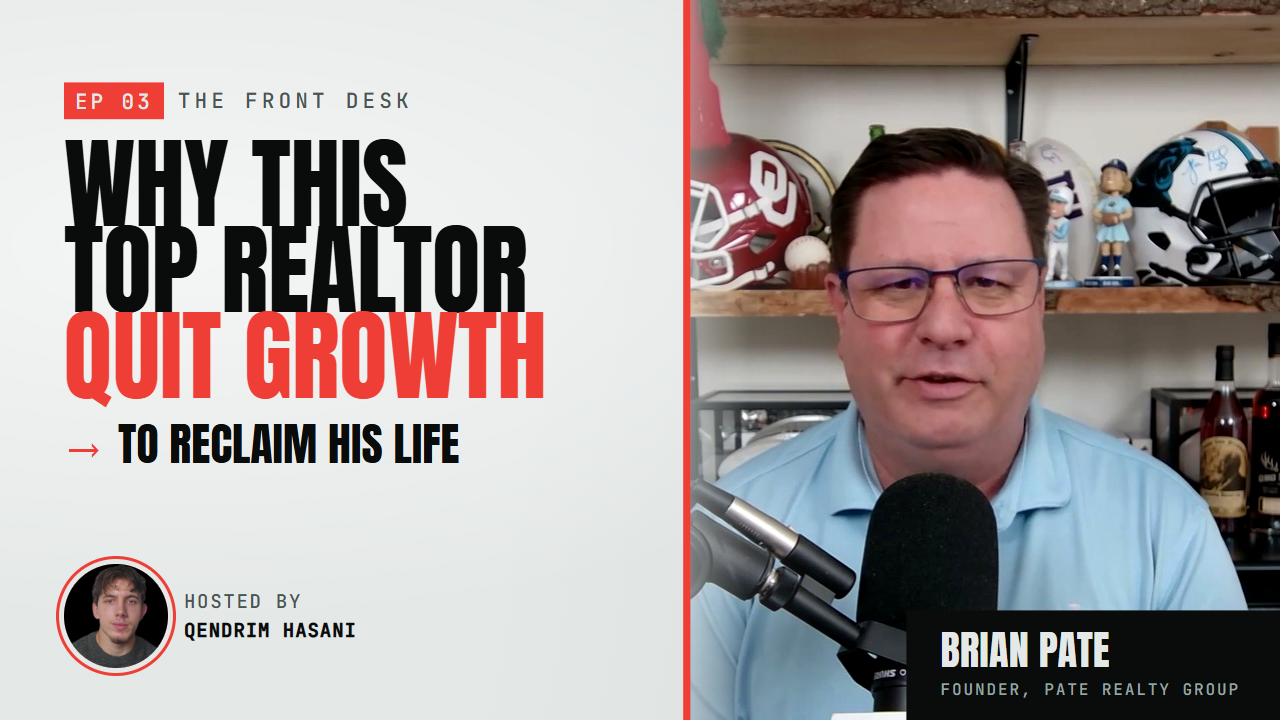
Brian Pate got his real estate license in 1993 after borrowing $180 from his grandparents to take the class. He went on to build one of the top real estate teams in North Carolina while also running the number-one wedding DJ company in the US, teaching real estate courses, and working part time as a ring announcer for World Championship Wrestling.
Then, at the top of his game, he deliberately shrank the business back down to just himself. In this episode he explains why. We get into his first mentor George Bell, a lupus diagnosis and two years of chemotherapy while building the business, the 2am near-miss with a drunk driver that made him sell his DJ company, letting his real estate team go in 2019 to become a one-man operation again, the AI business partner running on a Mac Mini in his house, and why he refuses to let AI anywhere near an actual client conversation.
What's in it
- The newspaper ad that got him into real estate
- Meeting his first mentor, George Bell
- A lupus diagnosis and two years of chemotherapy while building the business
- The 2am near-miss with a drunk driver that made him sell his DJ company
- Letting his team go in 2019 to become a one-man operation again
- The AI business partner running 24/7 on a Mac Mini in his house
- Why he won't let AI anywhere near an actual client conversation
- The one thing he'd fix with a magic wand
In his words
He encouraged me when I needed to be encouraged, he held me accountable when I needed to be held accountable, and he pushed me beyond what I would have done myself. George and I are still friends today, almost 35 years later from when I stepped foot in his classroom.
I have a business partner in my Claude account, and I have one of the Mac Minis that's running like a server in my house. It has access to every transaction I've completed in the last 10 years, every article I've written, every podcast I've been on. I'm saving myself 10 to 12 hours a week by having that artificial intelligence do most of my legwork overnight.
Blaming AI for your mistakes is kinda like blaming your pen for misspelled words. You're the one holding the key to it, you're the one giving the input, and you're the one that shared the output. If you share it and it's incorrect, that's a you problem.
My biggest magic wand would have a piece of paper falling from the sky every night that says, these are the 20 phone calls you need to make, and be able to do that in less than a couple of hours.
If I could have taken my ego and turned it into drive, I would've retired 15 years ago as a multi-billionaire.
Full transcript
Auto-generated from the episode audio, lightly corrected for names. Wording is as spoken, so it reads like speech rather than prose. The recording is the source of truth.
Qendrim
Hello. Uh, welcome to the third episode of the Front Desk podcast. Today we have Brian Pate, and for those that don't know you, can you tell them who you are and what do you do?
Brian
Sure. My name is Brian Pate. I am in the real estate business in the town of Youngsville, North Carolina.
I am, uh, in the US, uh, about 30 minutes north of Raleigh, which is the capital city. Um, I've been in the real estate business since 1993. I've also been an instructor.
Um, I started a couple of businesses when I was in high school and ran a DJ company in the United States where we did wedding receptions and stuff like that, but real estate's my passion, and it's what I do on a day-to-day basis these days.
Qendrim
Mm-hmm. And what got you into real estate from being a young guy who was into DJing and then going to real, uh, real estate business?
Brian
Yeah. So in all honesty, the, the mobile DJ business is a lot like the real estate business. You go out, you promote yourself.
Um, you know, when you deliver, you deliver, and you get those reviews and things like that. Um, it, it was kind of interesting. I was literally sitting around on a Wednesday morning, uh, reading the newspaper back when you used to read newspapers, and, uh, I saw an ad to take a real estate class, and it was 180 US dollars, and I didn't have 180 US dollars, so I, I borrowed some money from my, my grandparents, uh, to take the class.
Uh, the third night of class, I figured out I loved the information, I loved what I was working on, and a couple weeks later, I got my real estate license, and I was very fortunate I sold my first house less than a month into the game. Um, I bragged about how easy the business was, and six months later, I hadn't closed another house. So car- karma was a tester for me.
([chuckles])
Qendrim
I'm pretty sure you met your first mentor. I think his name was George Bell. Is that right?
Brian
His name was George Bell. That is correct. Very good.
Um, yeah, George was a person that, um, he encouraged me when I needed to be encouraged, he held me accountable when I needed to be held accountable, and he pushed me beyond what I would have done myself. Um, and that's, that's a big part of it, and George and I are still friends today, you know, almost 35 years later from when I stepped foot in his classroom.
Qendrim
That's amazing. How important do you think it is having a mentor when you're starting a new journey for you?
Brian
You know, I, I think everybody needs at least one mentor. Um, you know, my... Here in my family, we talk about the fact that it takes a village to raise kids.
Uh, and I think that people forget sometimes once they get into their 40s, mid-40s, and maybe even early 50s, you don't know it all, so you need someone else to give you a perspective that you may not have, and I think that's important to understand. I've got a circle of friends that I hang out with, and when I tell them to be hon- to be gut-wrenchingly honest with me, you know, let me have it. Tell me what I'm doing wrong here.
Be critical of me. Don't tell me what I want to hear. I think those are the mentors that are most important.
I think having fans that just tell you everything you do is the greatest thing ever, I think that's the worst position you can put yourself in. Um, but I, I think having somebody that'll truly tell you what they really think and will call you out when they think you're wrong, I think that's a, that's a big part of it, and I think that it also takes a very trusting relationship with whoever's doing that, whether they're your boss, whether they're another person in the office, whether they're a superior, um, somebody that's been in the business longer than you, whatever it may be. I think you have to have a mutual respect to be able to give and receive the information that's, that's, um, allowed, and you kinda lay your, your ground rules, you lay your boundaries down, and understand how, um, the two of you communicate when you do.
And, uh, so George, George was a big mentor of mine. My father was a huge influence on me. My dad was a newspaper publisher, um, and I don't...
I, I'm very fortunate that he's still around today at the age of 80. Um, but when I... I, I don't make a heavy decision without first going to a couple of mentors and having that discussion, and usually the first conversation is with my dad.
Qendrim
Mm-hmm. And I'm pretty sure your relationship with your dad was a bit broken after you dropped out of college. Is that right?
Brian
Yes. So when I, when I moved to Raleigh, um, I, I grew up in Myrtle Beach, South Carolina, and I moved to Raleigh in 1989. Uh, and my dad was not pleased with the fact that I was dropping out of school and that I was moving and was taking a job as a DJ.
He-- Little did he know that that was not the real reason I was coming. I was... I had taken a job as a ring announcer for World Championship Wrestling and was helping out with them occasionally.
And so it was, it was a pretty rough patch. Um, you know, Dad and I had our challenges, especially when I was in my 20s and my ego got the best of me on a couple of occasions. And, uh, ultimately, we were able to bury the hatchet and, and to this day, he's still, uh, one of my best friends in the world because he's always there for me.
Um, can't imagine life without him. I know that'll come one day.
Qendrim
Mm-hmm.
Brian
But, um, uh, I, I think that, I think that the relationship, you know, it, it, it progresses. Um, the... I, I don't think any relationship is perfect all the time, and I think it, i- in the same way that you have to work at your relationships with your spouse, you have to do the same with family.
And unfortunately, sometimes we treat family worse than we treat anybody else-
Qendrim
Mm-hmm
Brian
... because they're the closest to us. So I, I think that's a, a mistake that we all make, but it does happen.
And again, if the relationship is strong, you can, you can get through things like that.
Qendrim
Mm-hmm. And I think we often forget that the people closest to us, we-- it's a privilege for us to have them in our life, and a lot of time because we're so used to them being in our life, we just see them as a burden. But yeah, like-
Brian
Absolutely. I think a lot of times we get complacent and we don't work as hard at the relationships that we have every day. Whereas if, like, if I meet a new lead that's interested in selling a home or buying a home or investing in real estate, I'm on top of them.
I'm, you know, I'm talking to them every day. I'm becoming their best friend. I'm becoming their guidance counselor.
I'm becoming their advocate. And I think sometimes we should work at our, our personal relationships the same way that we do with our business relationships. I think it might be better in some occasions.
Qendrim
And how was you able to manage your personal relationships, the DJ business, being a ring announcer for wrestling, and then also getting into real estate? How did you know you was doing enough for all of them so they could all go evenly? Or was you just going one at a time?
Brian
Yeah. So I was, in, in that era from when I moved to Raleigh in '89 up until about 1999, um, between the nightclub business, the radio business, the DJ, the wedding business, the teaching business, the real estate business, I was working 70 to 75 hours a week.
Qendrim
Mm-hmm.
Brian
And burning the candle at both ends, as my mother used to say. And, um, eventually that catches up with you, and it did catch up with me. I, I have, uh, I was diagnosed with lupus back in 1993, and in, uh, 2000, after my first daughter was born in late 1999, um, I had nephritis in my kidneys, and so I went through a little over two years of chemotherapy for that.
Uh, so when 9/11 happened, for example, I had just had my chemotherapy the Friday before. That happened on Tuesday, and so I almost slept through all of it, had my phone not rang and people woke me up and said, "Hey, turn the phone on." I think that there are times when you can juggle multiple things, and I did that for a while, but it was very taxing on my body, on my emotions. It took away a ton of time, um, running the DJ business while still teaching and selling real estate, even in the 2000s as my kids were growing up.
That, that loss of time cost me time with my kids. I missed sleepovers. I missed birthday parties.
Um, you know, I missed day trips to the beach because I was working. Uh, so I, I think you have to be very careful and decide what are you willing to give. One of the things that I try to teach people is the value of the personal relationship with the family.
If, it doesn't matter if business is perfect if your relationship at home is off-kilter, um, and, and not on balance, and that includes your wife, your s- your husband, your kids, your significant other, whoever that may be. And so I, I think it's, it's something that I use in my coaching, uh, and my coaching clients will tell you, "Brian always asks when the last date I had with my spouse was," um, because that's one of the things that's important to a, to a work-life balance.
Qendrim
Mm-hmm. And a quote I found of you is you often say, "If you want to make your business big, you have to make your f-focus small," and like-
Brian
Man, you did your research on me. You did a good job. ([chuckles])
Qendrim
Thank you. How did you know when it was the right time to just quit the DJ business and go fully in real estate?
Brian
Yeah. That's, that's a great question, 'cause I'd had people... When I got into real estate, everybody told me how good I was gonna be at real estate and that I had a lot of potential and a, and a, a lot of capabilities to sell a lot of real estate.
Um, and so there, there was a time when I was a DJ part-timing as a real estate agent. And over time, back in the late 1990s with my last nightclub gigs and the early to mid-2000s, there started to be the pull with the, like I said, with my daughters being born, missing birthday parties, missing sleepovers. But it wasn't until, uh, I was on the way home from an event in 2013.
We had just been named the number one wedding DJ company in the United States for the second year in a row by, uh, a couple of different organizations, and I was on the way home, it was about two o'clock in the morning, and I was on an exit ramp, uh, from the highway, or as you guys would call, the motorway over there, and as I went to the exit, a car came the wrong direction. Turns out it was a drunk driver. He did not hit me, but he caused me to scrape my trailer and my truck up against the guardrail.
Um, and that was the moment I went, "Why am I putting myself out here? That could have taken me out." And I think it's that e-epiphany moment, uh, about the risk I was taking by working until two o'clock in the morning and things like that, you know, 'cause you never know what's going on. You can't control things after the sun goes down.
And so that was when I started thinking about it. I had formed my real estate team, uh, also in 2013, and we were starting to grow. At the time, my goal was to be one of the top 25 realtors in the, the state of North Carolina.
And so I decided in 2014 that I was gonna sell the company. I was fortunate enough to sell it to one of the DJs that had worked for me for many years, and he still runs it to this day. Um, but my last show was in 2015, and then in 2016, '17, and '18, we reached that goal of being one of the top teams in the state.
Um, and, and so it was that focus when I, when I, I'd always been told if I just focused on real estate, I was gonna be very good at it, and that kinda solidified that, that lesson that I had been taught. But it also made me want more. I wanted to grow bigger and bigger And eventually we grew too big.
Um, and in 2019, I realized I wasn't, uh, be- I wasn't friends with all of our clients like I had always been because we were doing 125, 130 transactions a year, but there was no way that I could possibly get to know all of our clients. The people that were working directly with me for, for listings, you know, we were doing 70 listings a year at that point, and I was doing all of them. So all of the sellers knew me, but none of the buyers knew me.
And so that became a problem for me. And so in 2019, um, we let a lot of the team leave by attrition, um, and then the last person left at her own free will of, uh, and accord, and I became a one-man operation again. So now when something goes wrong, I know who did it.
Qendrim
Mm-hmm.
Brian
I've, I've got total control over the business, but I also have total responsibilities to my family to be a provider because it's all, all on my shoulders at this point.
Qendrim
Of course. And how do you feel after reaching such a big accomplishment, something you've always wanted, and then just not losing it all, but choosing to let go? 'Cause, um, sometimes-
Brian
Yeah. So the... When I wanted to be one of the top agents in the state, that was ego-driven.
And after we got there, I realized nobody cared. The only people that cared were the other real estate agents that were competing against me, that were mad because they hadn't beaten me, or they were bragging because they had beaten me. Um, and, and I realized that it r- it really didn't matter what the production was.
The more important piece was, was I making enough to provide for my family? And so today, I sell maybe 20 to 25 homes a year, but because I'm not spending as much in my marketing and advertising and I'm not paying for other people's leads, uh, and paying them half of the commission when we create it, now I'm, I'm netting more money by being a one-man operation. And also by being a one-man operation, when I teach, nobody has to worry about me recruiting, uh, from their office because I don't want anybody else on my team anymore.
Uh, I wanna be a one-person operation. Now, I could use a couple of clones walking around that could, uh, do some things for me, like putting up signs and hosting open houses. But, uh, for the most part, I love what I do.
I love the day-to-day activities of it, and I love that process that I get to communicate with clients on a consistent basis, and hopefully, most of them become friends as a result of that.
Qendrim
And that's amazing. Um, a line I really like is, if you're doing what you want in life, then you already won. And it just seems-
Brian
Yeah
Qendrim
... like you're already doing that.
Brian
I've, I've been-- You know, the good Lord's been very good to me. I, I have a, I have a very strong faith, and I believe that, uh, I, I may not understand the path at the moment, but I believe that the Lord will provide, but that doesn't mean that I can just sit on the sideline and wait on things to come to me. I've got to be aggressive.
I've got to, to work every day. I've got to do the little things that matter, uh, that a lot of agents just are not willing to do.
Qendrim
Mm-hmm. And how do you manage to maintain that consistency over such a long period of time without failing or just stopping m- halfway through?
Brian
Yeah. So the discipline is, is number one as a small business owner. If you're not disciplined, you're gonna be, you're gonna be in shambles.
You know, the paperwork's gonna be all over the place. You're not gonna be organized. You're not gonna know, uh, you know, if, if you don't manage your calendar, you don't know what's on it.
You don't have a-- If you don't have a to-do list written down with everything, you're gonna forget things. And I, I, I have been fortunate enough, I use a lot of artificial intelligence in my business. I have a couple of agents that work for me that are, um, artificial intelligence agents.
I refer to them as AI employees. Um, and there's an executive assistant that helps me do a lot of the mundane things that I would normally do. It allows me to write my blogs and, and to create communications on behalf of things.
But it also allows me to do things like manage my website, manage lead generation, um, uh, lead capturing, lead identification, um, and allowing us to wash the information and make sure that it's a valid lead before we make a call. So all of those play in together. I just happen to be very fortunate that I don't really work for a living.
I do something that I'm passionate about, and because of that, I've never really worked a day in my life, to be honest with you. And life and work kind of coexist. There's a lot of people that talk about work-life balance, and I think that the, the more important phrase would be work-life coexist.
Because my wife understands occasionally there's gonna be a text that comes in at eight o'clock, I'm gonna go ahead and jump back on and, and respond to that text rather than waiting till the next morning. Uh, there will be times that I think I'm gonna be home at 5:00 that I don't make it home till 7:00, uh, and it's because we had to run an extra errand because something came up. You have to h- you know, you have to have that understanding at home.
It's very tough to be married to, to a real estate agent or be the significant other of a real estate agent because the ones that are most successful are so passionate about it, they're willing to do it 24 hours a day, and we almost have to make an effort to shut it down once in a while.
Qendrim
Mm-hmm. And I like how you mentioned artificial intelligence. Can I ask, how do you make sure even though you're getting the most out of it, you're not getting lost in it?
Brian
Yeah. So artificial intelligence for me and the way I teach it, and I've, I've been working with it now for almost four years. I was one of the very first...
I was in the first million to log on to ChatGPT and start playing with it like a toy. Um, and then I started thinking, as many did within a week, how can I use this for my business? How can I develop ideas?
And now I've got multiple systems that I use, but I have a business partner in my Claude account, and I have one of the Mac Minis that's running like a server in, in my house that is running through the Claude client. But it is capturing everything I do with my business. It has access to every transaction that I've completed in the last 10 years.
It has access to every article I've written. It has access to every podcast that I've been on, and it captures all of that information to create something that's customized for me. And while a lot of agents are sitting here saying, "Write me a description of my, of my listing so that I can advertise it on MLS," I'm out here saving myself 10 to 12 hours a week by having that artificial intelligence do most of my legwork overnight.
So all of my research is done overnight, all of my summarizations of news articles is done overnight. It creates a little, um, a 15-minute broadcast for me that I listen to while I'm doing my walking or exercises in the morning, and so I catch up on what's going on in the world, what's going on in the real estate business. Um, and so artificial intelligence is a key for me because not only am I using it separate and above, but it's also embedded in a lot of things that I'm using.
My website, both for my teaching and for my sales, are using artificial intelligence. My CRM, that's my customer relationship management system, is using artificial intelligence. I can do picture editing.
I can do virtual, uh, uh, staging with, with my vacant listings to have, you know, furniture placed based on what brand of furniture I want to use. I can make it look like an English tutor. I can make it, you know, what would it look like if we remodeled this home?
What would it look like with gray k- gray carpet instead of, uh, green carpet? And we can do those plays for our clients. So yeah, I'm, I'm using artificial intelligence heavily, uh, especially as a one-person operation because it's doing the work of probably three assistants that I could, could be spending, you know, $150,000 to $200,000 a year on, and I'm doing it for $100 a month from, from Claude, basically.
Qendrim
Mm-hmm. And what's the one thing you start by teaching your agents about AI to make sure that they actually im- implement it instead of just going over it?
Brian
Yeah. I think the most important thing to remember with AI, I, I have a lot of agents that ask me, "Hey, can you create a bot, a, a dialing bot that speaks to my clients when they call, or can you create an autoresponder with Gmail?" The answer is yes, we can, but we don't do that because the consumer is at the center of everything we do with artificial intelligence. Artificial intelligence should make the consumer experience better when it comes to being used by real estate agents.
So what are we doing to, in order to do that? Well, number one, we're i- we're using artificial intelligence to identify who the most likely purchasers of the home may be. We're doing predictive analytics in neighborhoods to decide who's the most likely to sell in this neighborhood and how can we communicate with them.
You know, that's what a lot of agents are not using it for. They're literally using it for listing descriptions and social media posts, and you can tell. I mean, the, the number of social media posts with artificial intelligence these days is at a level that's pretty much annoying, and it means that if you're using it properly, people don't realize that you're using AI.
If you're making it obvious that you're using AI, that's a bad thing. And unfortunately, um, people don't realize whenever it writes something for you, you need to proofread it. That is a f- that is a rough draft that you've just looked at when it gives you an output, and you need to go back in and edit it.
And of course, a lot of people are just copying and pasting whatever it gives them, and they're trusting it to be right. And as you get deeper into it, you feel like you, you notice that there's a lot more detail that you have to look at with the artificial intelligence output to make sure not only is the information factual and confirmed, but that it's also not discriminatory in any way so that you're not discriminating against race, color, religion, whatever it may be. And a lot of the artificial intelligence systems have a bias that's, um, unfortunately built into them because of the way people have used them.
Qendrim
Mm-hmm. I like how you said customers are like the center of the entire operation, and that using AI to communicate with them would just ruin that relationship you have with your customers and-
Brian
Yeah. When, when you run a business, the most important thing that you can do is be face to face or voice to voice with the next client. Why would we turn that over to a robot, for lack of a better term, when most of us, if we got a spam phone call, we'd hang up immediately?
Why would you want a bot doing the same thing on what could be a $10,000 or a $20,000 income because that person has called in to sell or buy a house? And you can't, you, you can't let that get in the way. You, you have to-- You still, as a real estate agent You must be able to communicate with people.
You must be able to provide, provide value in that communication, which means you gotta have market knowledge, you gotta understand what the market's done in the past, you've gotta be ab- able to predict a little bit what the market's gonna do in the future, and you have to identify, you know, for a buyer, which of these homes that you're interested in is in the best resale area. You know, for a seller, it's what's the ideal price in order to capture, uh, a bidding war or to, uh, create a quick sale rather than putting it 50,000 above the list pri- uh, above the value hoping to negotiate down. Those balances are always inherent in the real estate business, but they come from having conversations with the consumer.
And when they sign paperwork with me... You know, I, I look at it this way. If somebody signs a listing agreement and they wanna sell a $600,000 house with me, they've basically handed me $600,000 of, of their cash and said, "Take care of this for me." And that's where the, the, I think a lot of real estate agents miss their opportunity.
Qendrim
Mm-hmm. And of course, if AI messes up somehow, you can't just blame it 'cause it's just a tool. It's not a person.
Brian
Well, it's-- Blaming AI for your mistakes is kinda like blaming your pen for misspelled words.
Qendrim
([chuckles])
Brian
You're the one holding the key to it, you're the one giving the input, and you're the one that shared the output. So if, if you share it and it's incorrect, that's a you problem.
Qendrim
Mm-hmm. And can I ask, what's next for you in your business, and where are you trying to go in the next two to five years?
Brian
Yeah, that's, that's a great question. I am, um, I am at an age, I'm 57 years old. I'm at an age where we've got, uh, aging parents, both my wife and I do.
Uh, and we've got kids that are now in their 20s. So I, I think a lot for me is just maintaining what I have. I'm not really at this point in my career looking to grow to sell more houses.
I'm certainly not looking to work more.
Qendrim
Mm-hmm.
Brian
Um, but I think I can maintain where I am. Ultimately, when I do decide to step aside from selling real estate, I will probably still teach and train and coach. And I think in order to, to be able to do that validly, I'll probably continue to sell real estate here and there, and maybe sell five to seven houses a year, um, just so that I can still be active in the business and know what's going on.
But my, my-- at this point in my career, my focus is on teaching the next generation, uh, how to be successful in their business. Hopefully, they can learn some things from my mistakes that will cost them less money and make them more successful in less time, and that's the goal with, uh, the coaching that we do, is, is to allow the agents to grow into their own. I've got, um, one coaching client that's now the number one luxury agent in the entri- entire Raleigh-Durham market, and his wife is number six.
I've got another guy that's in my coaching group that's the number one agent in Henderson, North Carolina, and he's in the process of not only listing and selling real estate, but he's also building a property management company. In the first year and a half that we've been working together, he's, he's now managing almost 140 properties. So, um, we're, we've seen some success with the coaching program.
We've done a couple of AI boot camps to teach real estate agents the basics of how to use ChatGPT, Gemini, Claude, and Perplexity. Um, we've got multiple classes that I have written, uh, that are continuing education courses in North Carolina. Probably the next goal w- from the teaching standpoint is to get approved in a couple of other states and be able to offer not only continuing education, but also training classes that are not necessarily for credit, but to make you a better real estate agent.
Qendrim
Hmm. And you must get a ton of fulfillment from that, right?
Brian
Absolutely.
Qendrim
Yeah.
Brian
Absolutely. I had, uh... I, I have people come up to me all the time, "You taught my pre-licensing class in 1997 or 2010." And yeah, that, that makes my day when I see that they're still in the business.
And of course, probably my favorite thing is, uh, out of the top 25 to 30 agents in the Triangle market, probably 10 to 15 of them, uh, were people that came through my class. So I hope that, um, when they took their licensing class from me, that I inspired them, uh, in, into a business that I absolutely love. I, I, I always tell people, most, most people have one job that they can't stand, uh, and they spend their life trying to get away from it.
I have two jobs that I absolutely love, between listing and selling real estate and teaching real estate, and, uh, I, I, I think that's probably the best benefit for me, is that, like I said earlier, it's not work. It's just fun. Uh, and having that opportunity to give the keys to a first-time home buyer that's never owned before and, uh, follow them for the rest of their lives and help them sell the first home and buy the second one because they had a child, all of those things pay off.
Um, it's also a lot of fun when you're helping someone who's got an elderly parent that's moving to assisted living or, God forbid, the, the elderly parent or relative passed away and you're helping them with an estate sale. That's when the, the real passion in the business comes out to try to be, uh, as compassionate as we possibly can.
Qendrim
Mm-hmm. And even though you do take a lot of enjoyment out of both selling and buying, there must still be a problem in your business that you don't like doing. So if you had like a magic wand that could just take away the biggest problem in your business right now, what would it be?
Brian
Yeah, my biggest magic wand would have some-- I, I would have falling from the sky every night would be a piece of paper that says, "These are the 20 phone calls you need to make."
Qendrim
Mm-hmm.
Brian
Uh, and be able to do, be able to do that in less than a couple of hours. Um, that's always... You know, I, I don't like to rush my conversations because I like to get to know the people that I'm working with.
And even if they've listed or sold from me before, the ultimate compliment that I can get is for them to send me someone else that wants to sell a home, buy a home, or invest in real estate. And so w- that's, that's what we have to keep doing. Out of sight, out of mind, if you've ever heard that phrase, you always wanna make sure-
Qendrim
Mm-hmm
Brian
... that if somebody's thinking about real estate, then they know me. My hope is that they have been confident enough with what my service has been to them that they're willing to recommend me to their family and friends.
Qendrim
Mm-hmm. And I'm sure a lot of people will recommend you.
Brian
That's, that's how my business works.
Qendrim
Yeah.
Brian
It's, it's a lot of people that say, "Hey, I've got a friend," or, "This guy lives down the street from me, he needs to sell." Those... That's where probably 75% of my business comes from.
Qendrim
Mm-hmm. And if you could give your younger self one word of advice to just help him out, what would you tell him?
Brian
Oh, if, if I could have taken my ego and turned it into drive-
Qendrim
Mm
Brian
... I would've, I, I would've retired 15 years ago as a multi-billionaire. Um, I had a lot of great ideas back then.
Um, you know, before the internet, we had some ideas about doing some technology stuff with music that I now wish I had done. Um, we had an idea for a Napster-type setup long before Napster was there. Um, and it was a deal where we, we had created a, a prototype where you basically walked by and you touched it to a screen, and it downloaded all of the music for a certain genre that we had.
You know, there, there are things like that that I missed. Um, not finishing my, my university degree, uh, is something that I've regretted. I've, I've talked about going back just for my own edification, but unfortunately, I just don't have the time to do that with the schedule that we keep.
Uh, although down the road, that might be something that I do when I get close to retirement and have a little bit more time on my hands. So, um, you know, the, the, the bottom line is this: every day that the sun rises is a good day for me. Um, when the good Lord keeps me above the ground and feels that I still have a purpose on this earth, I'm gonna keep honoring Him and, and delivering that purpose to as many people as I possibly can.
Qendrim
Thank you so much to Brian for coming on this episode, and really appreciate you coming on here.
Brian
Absolutely, Chendan. I appreciate you having me. This has been fun.
Qendrim
Yeah, this has definitely been a lot of fun.
Episode 04 is being booked now